
The global agricultural machinery market is experiencing a structural pivot. As commercial poultry and swine farm operators face escalating operational pressures—including persistent feed price volatility, tightening environmental regulations, and acute rural labor shortages—the choice of farm infrastructure has become the ultimate determinant of profitability.
For B2B procurement managers, agricultural project contractors, and equipment distributors, sourcing the right machinery is no longer just about matching specifications; it is a high-stakes investment designed to future-proof operations for the next decade.
As a specialized manufacturer and systems integrator, QingDao Runfor Machinery Co., Ltd. works closely with international partners to deliver cutting-edge automation infrastructure, including bulk feed silos, precision pan feeding lines, chain feeding systems, and automated drinking lines.
To help international buyers navigate today’s complex supply landscape, this guide breaks down the core trends, material requirements, and evaluation frameworks shaping successful farm equipment sourcing in 2026.
In commercial broiler, layer, and swine production, operational margins are notoriously thin. Modernizing infrastructure is no longer an optional upgrade; it is an economic necessity.
Drastically Reducing Feed Waste: Feed accounts for 60% to 70% of total operational expenditure in modern livestock production. Precision-engineered pan feeders and closed-loop chain systems control feed distribution with microscopic accuracy, preventing animals from spilling feed and cutting total feed loss by 5% to 8%.
Optimizing the Feed Conversion Ratio (FCR): Continuous, hygienic access to fresh feed and clean water ensures uniform flock and herd growth, lowering mortality rates, reducing disease risks, and accelerating time-to-market.
Overcoming the Global Labor Deficit: With rural labor markets shrinking worldwide, integrated automation lines—featuring automated main feed lines, silo systems, and environment controllers—allow a single operator to manage tens of thousands of birds or hundreds of sows, slashing daily labor expenses by over 60%.
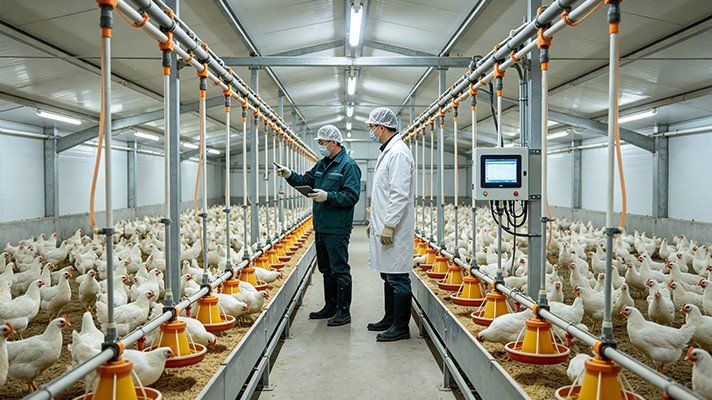
Professional procurement managers approach equipment sourcing through a rigorous, risk-averse lens. They prioritize Total Cost of Ownership (TCO) and long-term durability over initial low purchasing prices.
Livestock houses present highly corrosive chemical conditions driven by animal waste, high humidity, and concentrated ammonia. Professional buyers must strictly verify the following specifications:
Heavy Hot-Dip Galvanization: Support frames, suspension brackets, feed pipes, and outdoor silo sheets must feature thick, uniform zinc coatings (exceeding international standards) to completely inhibit rust, oxidation, and structural fatigue for 10 to 15+ years.
100% Virgin Engineering Plastics: Feed pans, corner wheels, and pressure regulators must be injection-molded using virgin PP and ABS plastics infused with advanced UV inhibitors to withstand intense thermal stress and mechanical wear without cracking or warping.
When importing heavy agricultural machinery from overseas, B2B buyers frequently worry about custom integration, factory credibility, and post-order support.
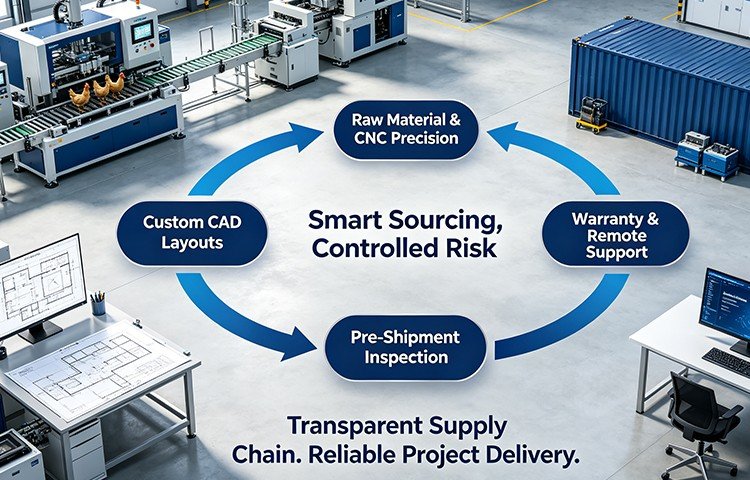
Tailored Engineering & CAD Layouts: Reliable suppliers never push rigid, off-the-shelf packages. They provide customized blueprints mapping out precise feed line pathways, water pressure regulation zones, and silo positioning based on your exact house dimensions.
Rigorous Multi-Stage Quality Control (QC): Look for suppliers who supervise production end-to-end—from raw material thickness testing and CNC manufacturing precision to pre-shipment inspections (PSI) and secure container loading supervision.
Robust After-Sales Risk Mitigation: Ensure your supplier backs their assets with solid manufacturer warranties, includes a complimentary percentage of high-wear spare parts (springs, pins, seals) in every container, and offers responsive remote technical guidance via digital platforms.
Upgrading your poultry or pig farm with high-performance automation is a strategic investment that defines your operational competitiveness. By prioritizing heavy-duty material standards, custom engineering precision, and transparent supply chain supervision, you can future-proof your enterprise against market volatility.
Are you planning an upcoming poultry or swine farm modernization project? Contact the engineering and sales team at Runfor Machinery today to request custom CAD layouts, comprehensive product catalogues, and competitive B2B project quotes.

Linda Chen: +86-18118895667
Melody He: +86-18661422586
Amy Shi: +86-18661885110
Vivian Ding: +86-18563936121
Kun: +86-18653203330
Linda Chen: market_bfs@163.com
Melody He: export_bfs@163.com
Amy Shi: Amyshivip@vip.163.com
Vivian Ding: sales_bfs@outlook.com
Please subscribe to our email and we will reply to youas soon as possible.
Copyright © 2022 QingDao Runfor Machinery Co.,Ltd., All Rights Reserved. Powered by HiCheng
(Sitemap)